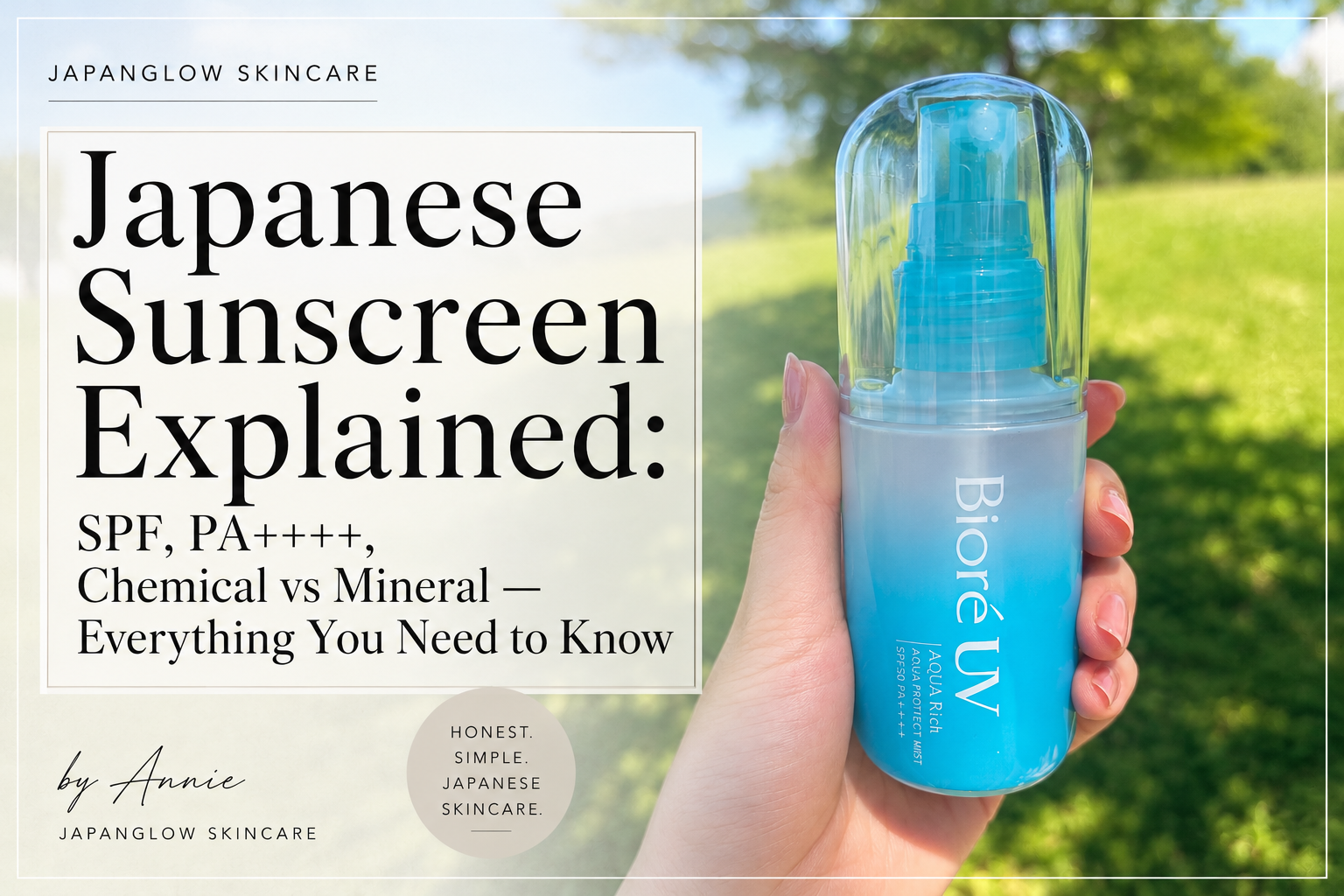
Have you ever picked up a Japanese sunscreen and stared at the label thinking — what on earth does SPF50+ PA++++ even mean? You’re not alone. By the end of this post, you’ll know exactly what it all means and which Japanese sunscreen is right for you!
Japanese sunscreens have earned a devoted following all over the world — and for good reason. I was born and grew up in Japan, and my mom drilled it into me from a young age: “Never skip your sunscreen!” These days, new and improved formulas hit the shelves every single year, and honestly? Picking out a new sunscreen every summer has become one of my favorite beauty rituals.
Whether you’re hunting for the perfect sunscreen for this summer, or you’re just curious about what PA++++ actually means, this guide is for you. Here’s everything you need to know about Japanese sunscreen!
What is UV Radiation? UVA vs UVB
UV radiation is divided into three types based on wavelength: UV-A, UV-B, and UV-C. Of these, only UV-A and UV-B actually reach the earth’s surface — and both affect your skin in very different ways.
UV-A: The Cause of Wrinkles and Sagging
UV-A makes up about 90% of all UV radiation that reaches the ground. It penetrates deep into the dermis (the deeper layer of your skin), and while it doesn’t cause immediate redness, the cumulative damage leads to wrinkles, sagging, and loss of elasticity over time. UV-A rays can pass through glass — so yes, you can get UV-A exposure even sitting by a window indoors.
UV-B: The Cause of Sunburn and Dark Spots
UV-B accounts for roughly 10% of UV radiation at ground level. Unlike UV-A, it doesn’t pass through glass, so it mainly affects you outdoors. UV-B damages the outer layer of the skin (the epidermis), causing the painful redness and burning known as sunburn. Over time, it triggers melanin production, leading to dark spots and freckles.
| UV-A | UV-B | |
|---|---|---|
| Skin concern | Wrinkles, sagging | Sunburn, dark spots |
| Skin layer affected | Dermis (deep) | Epidermis (surface) |
| Passes through glass? | Yes | No |
| % of UV at ground level | ~90% | ~10% |
What Does SPF and PA++++ Mean?
Now that you know the difference between UV-A and UV-B, it’s easy to understand what SPF and PA measure:
- SPF = protection against UV-B (sunburn, dark spots)
- PA = protection against UV-A (wrinkles, sagging)
SPF — Sun Protection Factor
SPF measures how long the sunscreen can protect your skin from UV-B rays. As a rough guide, SPF 1 is said to extend your skin’s natural protection by about 20 minutes. So SPF 30 gives you approximately 600 minutes of protection — though in real life, sweat, water, and friction reduce effectiveness, which is why reapplying is so important.
PA — Protection Grade of UVA
The PA system was developed in Japan by the Japan Cosmetic Industry Association (JCIA) to standardize UVA protection ratings across brands. The more plus signs, the higher the protection:
| PA Rating | UVA Protection Level |
|---|---|
| PA+ | Some protection |
| PA++ | Moderate protection |
| PA+++ | High protection |
| PA++++ | Extremely high protection |
How to Choose the Right SPF/PA for Your Day
Higher numbers mean stronger protection — but also heavier formulas that can be harder to remove. Match your SPF/PA to your daily activities:
| Activity | Recommended SPF | Recommended PA |
|---|---|---|
| Daily errands, commuting, walking | SPF10–20 | PA+ to PA++ |
| Outdoor sports, short leisure activities | SPF20–40 | PA++ to PA+++ |
| Beach, long outdoor activities, sports | SPF30–50+ | PA+++ to PA++++ |
Two golden rules of sunscreen:
- UV rays are present year-round — even on cloudy days and through windows. Make sunscreen a daily habit.
- Reapply every 2–3 hours, and after sweating, swimming, or any rubbing against clothing or towels.
Chemical vs Mineral Sunscreen
All sunscreens work using one of two types of UV-blocking ingredients — or a combination of both. Understanding the difference helps you choose the right formula for your skin type and lifestyle.
Chemical Sunscreen (UV Absorbers)
Chemical sunscreens work by absorbing UV rays and converting them into heat, which is then released from the skin. Think of it like a sponge soaking up UV radiation before it can damage your skin.
These formulas tend to be lightweight, smooth, and easy to blend — making them ideal for everyday wear and under makeup. However, for some people with sensitive or reactive skin, the UV-absorbing process can occasionally cause irritation or dryness.
Common chemical UV filter ingredients:
- Ethylhexyl Methoxycinnamate (Octinoxate) メトキシケイヒ酸エチルヘキシル(or called オクチノキサート)
- Diethylamino Hydroxybenzoyl Hexyl Benzoate (ジエチルアミノヒドロキシベンゾイル安息香酸ヘキシル)
- t-Butyl Methoxydibenzoylmethane t-ブチルメトキシジベンゾイルメタン(or called アボベンゾン)
Mineral Sunscreen (UV Scatterers)
Mineral sunscreens work by reflecting and scattering UV rays away from the skin — like a protective veil sitting on the surface of your skin. Products made with only mineral filters are often labeled “non-chemical” in Japan.
These are generally gentler on sensitive skin and easier to rinse off. The trade-off? They can sometimes leave a white cast, especially on deeper skin tones.
Common mineral UV filter ingredients:
- Zinc Oxide (酸化亜鉛)
- Titanium Dioxide (酸化チタン)
| Chemical (UV Absorber) | Mineral (UV Scatterer) | |
|---|---|---|
| How it works | Absorbs UV rays | Reflects & scatters UV rays |
| Texture | Lightweight, blends easily | Can feel heavier, white cast possible |
| Best for | Daily wear, under makeup | Sensitive skin, babies, reactive skin |
| Key ingredients | Octinoxate, DHHB, etc. | Zinc Oxide, Titanium Dioxide |
Many Japanese sunscreens use a hybrid formula — combining both chemical and mineral filters to get the best of both worlds: strong protection with a lightweight, wearable finish.
Why Japanese Sunscreen is Different
The Science: More Approved Ingredients = Better Formulas
One of the biggest reasons Japanese sunscreens feel so different from Western ones comes down to regulations.
In the United States, sunscreen is classified as an over-the-counter drug, which means every ingredient must go through the FDA approval process. The FDA has only approved 16 UV filter ingredients — and the last new approval was back in 1996. In contrast, the EU and Japan have approved 30+ UV filter ingredients, including many newer, more advanced options that allow for lighter, more skin-friendly formulas.
Here’s a surprising real-world example: Biore sunscreens sold in the US may contain different ingredients than the same brand sold in Japan, because some of Japan’s key UV filters are not yet FDA-approved.
| United States | Japan / EU | |
|---|---|---|
| Sunscreen classification | OTC drug | Quasi-drug / Cosmetic |
| Approved UV filters | 16 ingredients | 30+ ingredients |
| Last new approval | 1996 | Updated regularly |
| Typical texture | Heavier, white cast common | Lightweight, no white cast |
| UVA protection rating | No PA system | PA++++ system |
🆕 2025–2026 Update: The FDA has proposed approving bemotrizinol — a UV filter already widely used in Japan and Europe — marking the first potential new sunscreen ingredient approval in nearly 30 years. If passed, American sunscreens may finally start to catch up.
The Culture: Why Japan Takes Sun Protection So Seriously
Beyond the science, there’s a cultural layer worth exploring. East Asian beauty standards have traditionally placed high value on fair, clear skin — which has driven enormous demand for effective sun protection across Japan, Korea, and China for decades.
This demand likely fueled the innovation we see today: Japanese sunscreens don’t just protect from UV rays — they also moisturize, prime, brighten, and even fight signs of aging. And impressively, many of the best options are available at drugstore prices.
I find this intersection of culture, beauty standards, and skincare science fascinating — and I plan to dig deeper into it in a future post. Stay tuned!
What sets Japanese sunscreens apart:
- Feather-light textures that sit beautifully under makeup
- Easy to remove with regular cleanser or soap
- No greasy or overly drying finish
- Available in multiple formats: liquid, stick, powder, spray, and more
- Multi-functional: brightening, anti-aging, primer, and active skincare ingredients all in one
- Excellent quality at drugstore-friendly prices
Annie’s Personal Favorites — My Top Picks
Every summer, I look forward to trying new sunscreens — but there are a few that I keep coming back to year after year. Here are my personal holy grail picks:
1. Mommy UV Aqua Milk — My Everyday Staple
Type: Chemical | SPF50+ PA++++
This is the one I reach for every single morning without fail. I’ve been repurchasing it for years, and it never lets me down. It doesn’t clog my pores, sits invisibly under makeup, rinses off easily, and is gentle enough for days when my skin is feeling reactive or sensitive. Truly a no-fuss, all-season essential.
📍 Available at Japanese drugstores and online.
2. Biore UV Aqua Rich Aqua Protect Mist — SPF50+ PA++++
Type: Chemical | SPF50+ PA++++
My go-to for touch-ups throughout the day. It’s perfect for spritzing on your neck and even your hair — anywhere that’s tricky to reapply a lotion or cream. Unlike most spray sunscreens that come in aerosol cans (a recycling headache!), this one comes in a plastic bottle and even has a refillable option. I genuinely use this year-round.
📍 Available at Japanese drugstores and online.
3. ANESSA Perfect UV Skincare Milk NA — SPF50+ PA++++
Type: Hybrid (Chemical + Mineral) | SPF50+ PA++++
When I absolutely cannot afford to get any color — think beach days, outdoor events, or wearing sandals in summer — this is my ride-or-die. I genuinely trust this sunscreen not to let me get burned. It’s also my secret weapon against sandal tan lines. Reliable, powerful, and worth every yen.
📍 Available at Japanese drugstores, department stores, and online.
What’s Trending in Japan Right Now
Every year, new sunscreens hit Japanese shelves — and keeping up with what’s trending is half the fun. I checked the rankings on @cosme, Japan’s largest beauty review platform with over 16 million members, to find out what Japanese people are actually buying and loving right now.
| Rank | Product | Brand | SPF/PA | Type | Price (est.) |
|---|---|---|---|---|---|
| 🥇 1st | Perfect UV Skincare Gel NB | ANESSA | SPF50+ PA++++ | Chemical | ¥1,496–¥2,508 |
| 🥈 2nd | Chrono Beauty Gel UV EX | ALLIE | SPF50+ PA++++ | Hybrid | ¥2,310 |
| 🥉 3rd | Hyaluron Serum UV | Skin Aqua | SPF50+ PA++++ | Chemical | ~¥1,000 |
| 4th | Mermaid Skin Gel UV | CANMAKE | SPF50+ PA++++ | Chemical | ~¥1,000 |
| 5th | Cream in Day | KANEBO | SPF50+ PA++++ | Chemical | ~¥3,300 |
| 6th | Sun Shelter Multi Protection Tone Up CC | COSME DECORTÉ | SPF50+ PA++++ | Hybrid | ~¥5,500 |
| 7th | UV Deep Protect & Care Gel | NIVEA | SPF50+ PA++++ | Chemical | ~¥1,000 |
| 8th | Perfect UV Skincare Milk NA | ANESSA | SPF50+ PA++++ | Hybrid | ~¥2,200 |
By Price Range
| Budget | Recommended Picks |
|---|---|
| 💚 Drugstore (under ¥1,500) | CANMAKE, Skin Aqua, NIVEA UV |
| 💛 Mid-range (¥1,500–¥3,000) | ANESSA, ALLIE |
| 💜 High-end (¥3,000+) | COSME DECORTÉ, KANEBO |
Find Your Perfect Japanese Sunscreen
By Skin Type
| Skin Type | Recommended Product | Type | Price | Why It Works |
|---|---|---|---|---|
| Oily / Combination | ANESSA Perfect UV Skincare Gel NB | Chemical | ¥1,496+ | Lightweight, non-sticky, water and sweat resistant |
| Dry skin | ALLIE Chrono Beauty Gel UV EX | Hybrid | ¥2,310 | Moisturizing finish, hyaluronic acid, no dryness |
| Normal / All skin types | Skin Aqua Hyaluron Serum UV | Chemical | ~¥1,000 | Water-like texture, waterproof, great for face and body |
| Sensitive skin | ANESSA Perfect UV Mild Milk NA | Hybrid | ~¥2,200 | Fragrance-free, alcohol-free, colorant-free. Safe for babies |
| Sensitive + prefers mineral | ANESSA Mineral UV Mild Gel | Mineral only | ~¥2,500 | Zero UV absorbers, non-chemical formula, gentle for babies |
By Lifestyle & Preference
| Your Need | Recommended Product | Type | Price | Why It Works |
|---|---|---|---|---|
| Use as makeup primer | ALLIE Chrono Beauty Tone Up UV | Hybrid | ¥1,980 | Smooths texture, corrects uneven tone, keeps makeup in place all day |
| Maximum protection (outdoor/sports) | ANESSA Perfect UV Skincare Milk NA | Hybrid | ~¥2,200 | Super waterproof, friction-resistant — my personal most-trusted formula |
| Easy to remove | ALLIE Chrono Beauty Gel UV EX | Hybrid | ¥2,310 | Rinses off with regular face wash or body soap |
| Budget-friendly | CANMAKE Mermaid Skin Gel UV | Chemical | ~¥1,000 | SPF50+ PA++++ at an unbeatable price point |
| Tone up / brightening | ANESSA Brightening UV Gel NA | Chemical | ¥1,496+ | Lavender-pink tint corrects dullness and adds a natural glow |
| Easy touch-ups on the go | ANESSA Perfect UV Skincare Spray NA | Chemical | ¥1,958 | Works on face, body, hair, and over makeup — one bottle does it all |
| Deep hydration | Skin Aqua Hyaluron Serum UV | Chemical | ~¥1,000 | Hyaluronic acid-focused formula, no heaviness even when layered |
| Eco-conscious | ALLIE Chrono Beauty Milk UV EX | Hybrid | ¥2,310 | Beach-friendly formula, assessed for water environment impact |
Why Are Most Japanese Sunscreens Chemical?
You might have noticed that almost every product on this list is a chemical (UV absorber) type — and that’s no coincidence.
As we covered earlier, Japan has access to a much wider range of approved UV filter ingredients than the US. This gives Japanese formulators the freedom to work with advanced chemical filters that are lightweight, skin-friendly, and easy to wear under makeup. The result? A market full of chemical sunscreens that actually feel good on the skin — no greasiness, no white cast, no heavy residue.
This is exactly why Japanese sunscreens have earned such a devoted following around the world.
What if you prefer mineral sunscreen? If you have reactive skin, are pregnant, or simply prefer to avoid chemical UV filters, ANESSA Mineral UV Mild Gel is the standout option on this list. It uses zero UV absorbers and is gentle enough for babies — while still delivering solid SPF50+ PA++++ protection.
Final Thoughts
Japanese sunscreen isn’t just about blocking UV rays — it’s a whole philosophy of skin protection built on decades of innovation, advanced ingredient science, and a deep-rooted cultural appreciation for healthy, protected skin.
Whether you’re a first-timer or a longtime J-beauty fan, I hope this guide helps you find your perfect match. And remember: the best sunscreen is the one you’ll actually wear every day.
Have questions about a specific product, or want a personalized recommendation for your skin type? Drop a comment below — I’d love to help!
References
Product Information & Rankings
- @cosme Face Sunscreen Ranking: cosme.net/categories/item/1037/ranking/
- @cosme By Age Ranking: cosme.net/categories/item/1037/ranking-age/
- @cosme Rising Fast Ranking: cosme.net/categories/item/1037/ranking-rise/
- ANESSA Official (Shiseido): shiseido.co.jp/anessa/products/suncare/perfect_uv_gel/
- ALLIE Official (Kanebo) FAQ: kanebo-cosmetics.jp/allie/qa/
- Mamy UV Aqua Milk (Isehan): onlinestore.isehangroup.jp/products/000000000080/
- ANESSA Perfect UV Skincare Milk NA: shiseido.co.jp/sw/onlinestore/products/H16501.html
- MyBest — ANESSA Review: my-best.com/products/2039845
- MyBest — ALLIE Ranking: my-best.com/18909
- Kakaku.com — ALLIE Comparison: kakaku.com/cosmetic/sunscreen/itemlist.aspx?pdf_se=27
FDA Regulations & US vs Japan Sunscreen
- EWG — International Sunscreens: ewg.org/news-insights/news/2024/05/what-you-need-know-about-international-sunscreens
- EWG — US Sunscreen Regulation: ewg.org/news-insights/news/2025/06/how-sunscreen-ingredients-are-regulated-us
- NBC News — FDA Sunscreen Ingredients: nbcnews.com/health/health-news/us-sunscreen-fda-ingredients-uv-protection-rcna150307
- NPR — Sunscreen & FDA: npr.org/sections/health-shots/2024/05/18/1251919831/sunscreen-effective-better-ingredients-fda
- Scientific American — US Sunscreen Reform: scientificamerican.com/article/u-s-sunscreens-arent-great-the-fda-could-soon-change-that/
- PMC Academic Paper: pmc.ncbi.nlm.nih.gov/articles/PMC12332967/
Ingredient Analysis
- Coloria Magazine — ALLIE Ingredients: coloria.jp/magazine/articles/yn43e
- BAILA — ANESSA & ALLIE Comparison: baila.hpplus.jp/beauty/make/64783
- MAQUIA — ANESSA Lineup: maquia.hpplus.jp/skincare/matome/117182/
コメント